[Experiment 3] Building a Data Center Simulator Game to Learn about Computers Before I build My Homelab Compute Cluster
Yes so this one is clearly a little different experiment. My focus in general is AI, costs and agents. I didn’t want to add it as an experiment but I feel I should write down some notes so let’s call it an experiment
The logic here is, I learn about computers through a game that I will create and then play, so I will better be able to understand the constraints around what is needed in order to build a good local homelab. With this homelab I plan to run some local LLMs instead of paying for expensive API. And also keeping my private questions private and not shared with Anthropic or OpenAI.
But the home computer lab will be another future experiment. Probably after the holiday season
I have had this ideas for a long time that the best way to learn something is by playing games about the subject. I guess it started off because I learned coding primary through Codingame.com. After that, I even built PlaySupplyChain.com for learning supply chain.
So anyway, because I already own a website and because it is structured the way I want (Django backend and HTML/JS/CSS frontend), I thought I could add a game.
As I have created quite a few small games in the past (mainly with three.js or phaser.js), I can in this case just create a detailed prompt and Cursor AI/Fable 5 will solve the rest and add it to my website.
The game is really about learning, it will be easy for anyone to cheat with high score as game logic is in the frontend and there is minimal validation in the backend
As a short comment, normally with Django backend and javascript front end, the best way will be to have all the game logic in the backend in a consumer.py file and maybe some other files like game_state.py and whatever is needed. Front end will be graphics interface and movement etc. There is of course also a special setup in order to activate websocket between front and back for continuous updates.
In the case of this data center simulator game, everything is in the front code and I don’t even obfuscate it.
The game can be played for free and without signup or even sharing an email in the browser here: https://www.buildlooplabs.com/hyperscale/
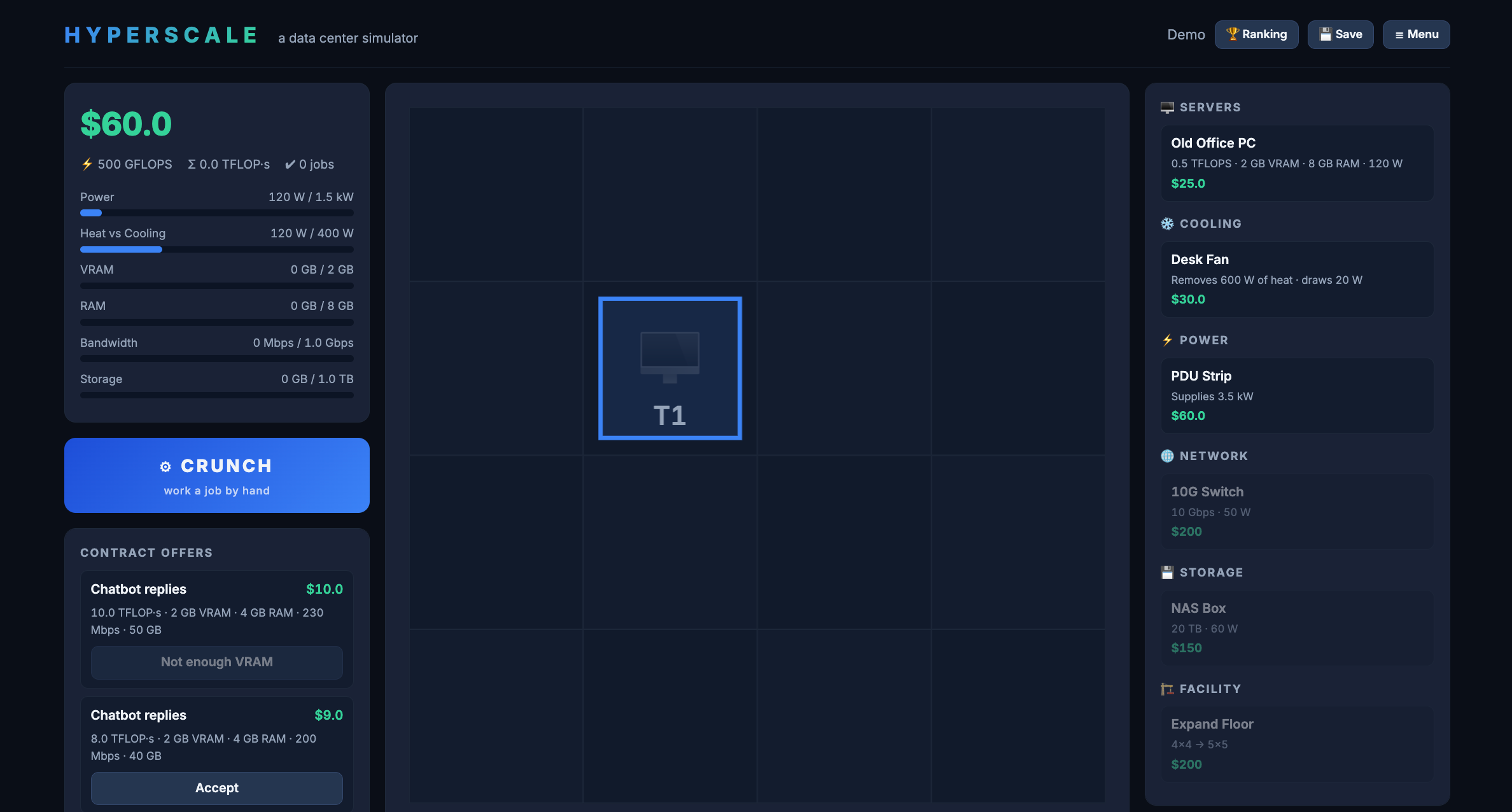
The game is honestly pretty easy to grasp. If you look at the screenshot below, you can see that there are 4 sections of the screen in the game:
- Top left which is about the amount of money the player got plus the capacity in each of the 6 key areas which are; Power, Heat vs Cooling, VRAM, RAM, Bandwidth, Storage
- Bottom left which is the contracts available, the technical constraints for each contract and how much it will pay. The processing power (compared to the players available power) will indicate how long time it will take to complete the task
- Middle, which is a 4 x 4 grid in the beginning where the user can add components to improve the performance. The grid can be expanded later on for a cost
- Right side, which is where components appear if the player wants to add them to the grid. Initially there are not many components available but more advanced components does get available later on
The Key Learning for my future local AI homelab
What I want to remember is the following:
- FLOPS is floating operations per second and is basically an indication of how fast the computer can do operations. The higher the better and very likely some link with the famous token per second number
- VRAM is a real qualifier. If the VRAM is not there it is likely that jobs/or a certain local LLM will just not be possible to hold in the memory
- Compute eats energy so this will consume a lot with more FLOPS
- Bandwidth need not to slow down any operations. I think for me it can easily become the bottleneck if I want to connect several cheaper graphics cards together
- Heating is about how easily it overheats. The need for cooling becomes more important the more compute that is active
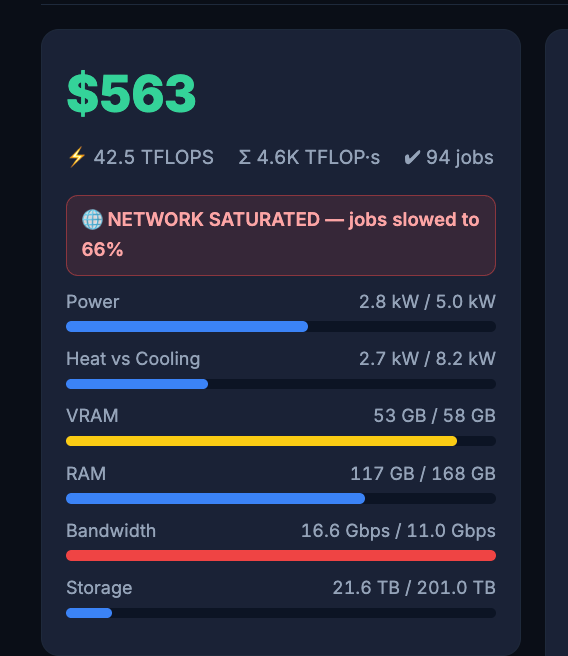
We can see in the screenshot that things break down if one of the area goes above its limit:
Suggestions for next version
I think the game is quite high quality. There are, of course, quite a few things that can improve. The most important thing will be to create some kind of urgency. Either to make real time pass (like 10 years), or a limited number of contracts or something. The reason for the urgency is that basically for the high score, someone can just make sure they get basic income and then they can leave the game on forever and they will beat the high score.
The next thing will be around animations and graphics. Game looks very boring now and could look better.
The third thing will probably be to make to mobile compatible.
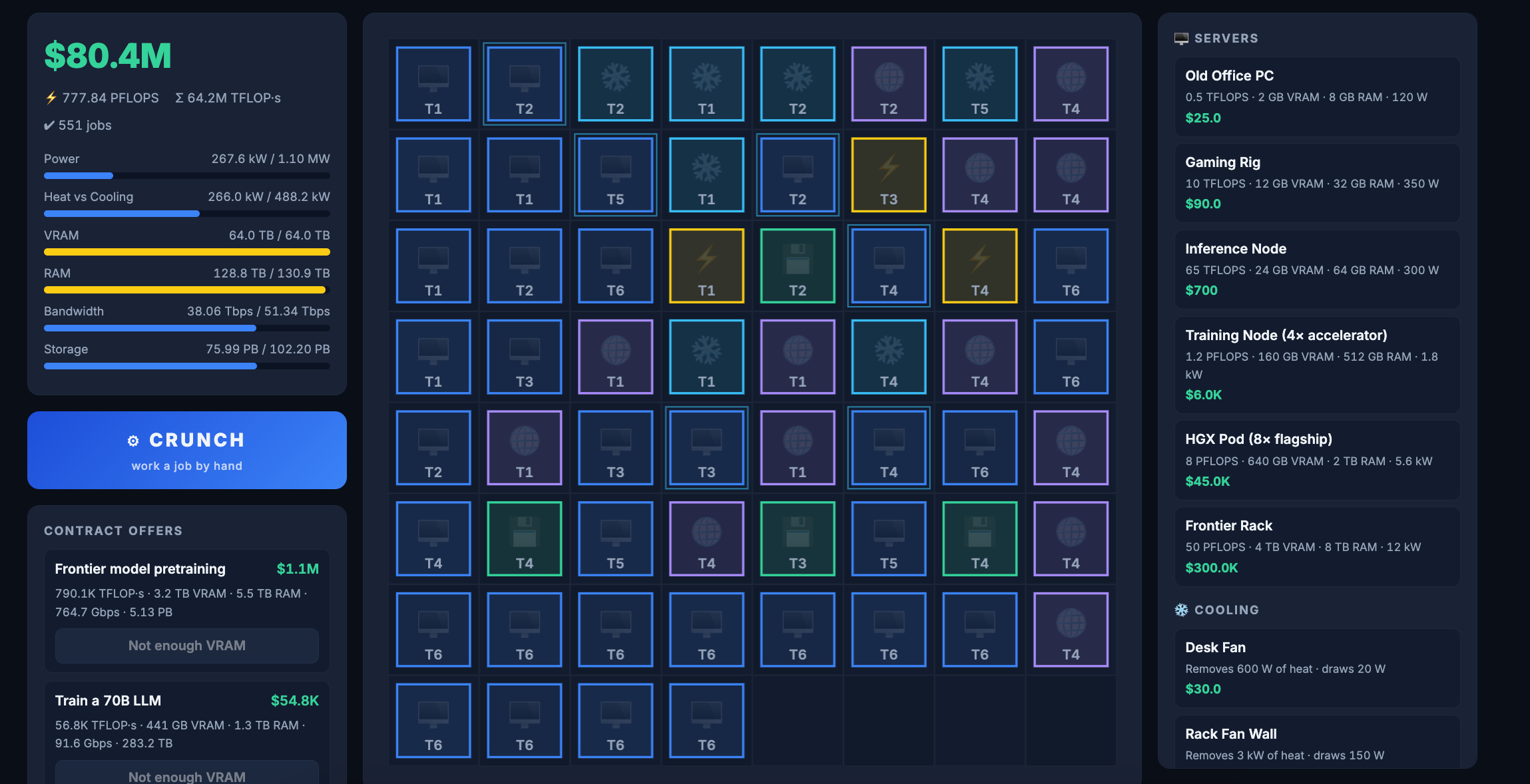
Another screenshot how it looks later on:
Conclusion
I do actually think it is a really good thing to learn by playing and these days, a user can literally build a learning experience through a game in 1-2 prompts in half a morning. What a game like that does, is in reality to take the knowledge (in this case of Claude Fable 5) and translate it into a game. Something that is more attractive than maybe watching a youtube video or learning through reading or even compared to talking to AI.
In terms of my personal interest to understand computers, I think this game brought me forward quite some. It could have pushed it further but definitely it was ok.
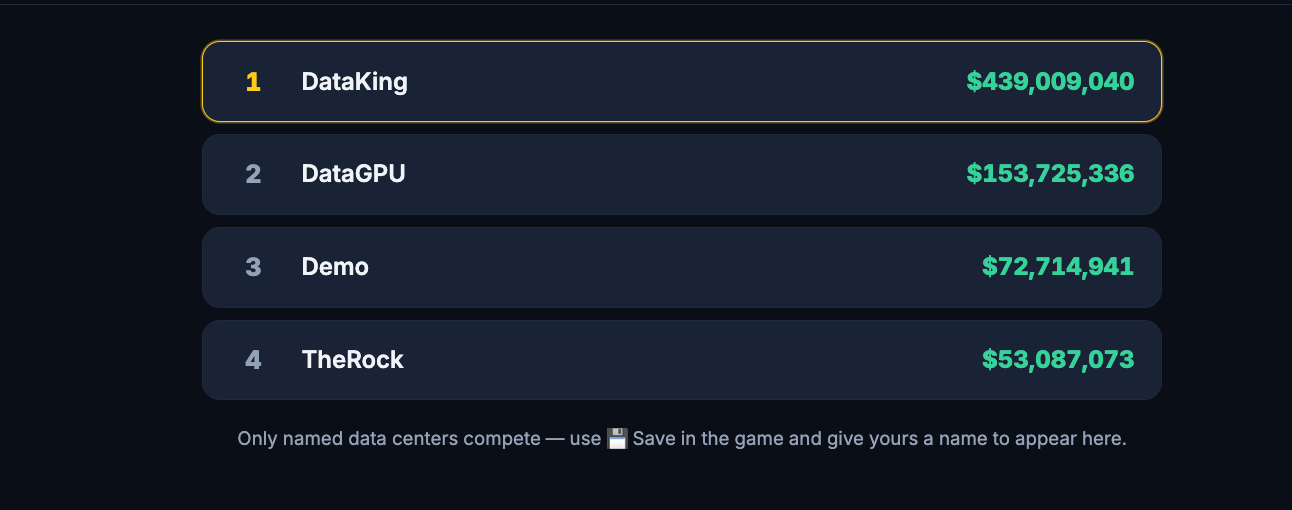
Now the question is if anyone else will play it and if they will beat my high score
Thanks
Andreas